
The region determines the approach.
Five countries. Five distinct operating environments. Each one requiring a different operational approach.
Five realities that
define the approach.
Reaching Programme Sites Beyond the Network
Programme sites in South Sudan, DR Congo and Somalia lie beyond established logistics networks. Last-mile delivery is the primary challenge here.
Across East Africa, many programme sites and beneficiary communities sit beyond established logistics networks. In South Sudan's flood affected regions, DRC's eastern operational zones and Somalia's conflict affected interior, last-mile delivery is not a finishing problem. It is the primary logistics challenge. These are not edge cases. They are where the programme is.
When the Calendar Changes What Is Possible
Seasonal flooding and rains across South Sudan, Ethiopia and DR Congo determine what routes and timelines are achievable, not just when.
Across East Africa, seasonal conditions do not delay logistics. They change what is logistically possible. South Sudan's annual flooding renders established transport routes impassable for weeks at a time. Ethiopia's rainy season restricts vehicle movement on unpaved access roads to highland programme sites. In eastern DRC, access windows open and close with conditions that cannot be forecast from outside the field. Logistics planning must account for these cycles in advance. Responding to them as they occur is too late.
Cross-Border Corridors That Require Active Management
Movements through the Kenya to South Sudan, Kenya to Ethiopia and Kenya to Somalia corridors require active customs facilitation at every crossing.
East Africa's humanitarian and development corridors cross international borders that each carry distinct customs frameworks, documentation requirements and clearance timelines. The Kenya to South Sudan corridor, the Kenya to Ethiopia route and the Kenya to Somalia access route are the primary movement channels for programme supplies across the region. Each requires pre-clearance documentation, active customs facilitation and corridor specific operational knowledge. Without these, a border crossing becomes a supply chain delay that the programme absorbs, not the logistics partner.
Operating Where Access Is Not Guaranteed
In Somalia and South Sudan, access is negotiated and confirmed in the field, with security coordination built into every movement plan.
In Somalia's conflict affected south and South Sudan's active operational zones, logistics movement requires security coordination at every stage of transit. Access is negotiated, not assumed. Delivery windows are confirmed in the field. They cannot be fixed from a planning centre in advance. A logistics partner operating in these environments must treat security awareness as a baseline operational requirement built into every movement plan, not as a specialist service added after the engagement is already underway.
The Infrastructure Reality of Regional Supply Chains
Beyond Nairobi and the Port of Mombasa, regional infrastructure is seasonal and capacity is unpredictable. Planning has to account for that variability directly.
East Africa's humanitarian supply infrastructure, the ports, corridors, storage facilities and ground transport networks that move goods from origin to programme site, is not uniform. Nairobi functions as the regional hub. The Port of Mombasa is the primary deep water entry point for the region. Beyond these anchors, the infrastructure becomes progressively less predictable. Roads are seasonal. Storage is constrained. Transport capacity fluctuates. Logistics operations must be planned for the infrastructure as it is, not as a standard model assumes it should be.
Five countries, each with its own operating conditions.
Swiftaid operates in East Africa. It does not advise on it.
- Field delivery execution
- Cross-border coordination
- Programme continuity under changing conditions
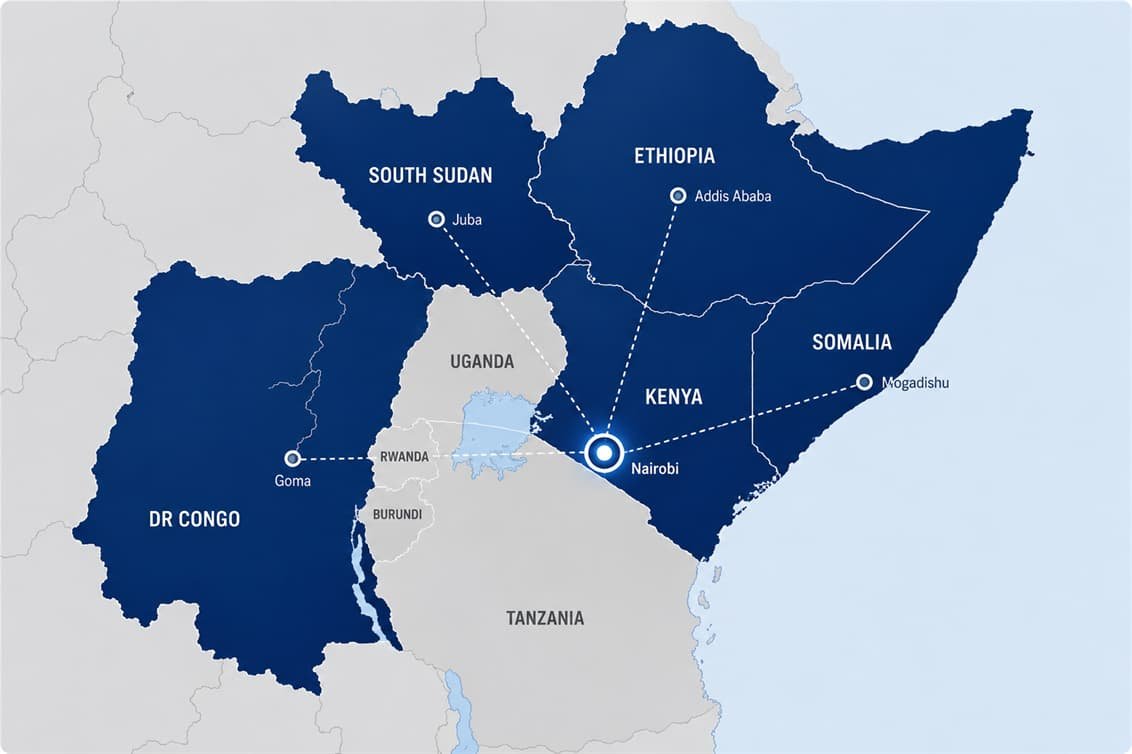
Five Countries.
Five Operating Profiles.
Swiftaid maintains operational presence across East Africa. Each country entry reflects capability, not a map entry.
Kenya
Regional HubRegional logistics hub and corridor origination point. Nairobi anchors East Africa's humanitarian and development supply chain. Mombasa provides the primary deep water entry point for the majority of cross border programme movements.
South Sudan
Complex AccessSeasonal flooding and conflict affected access conditions shape every movement plan in South Sudan. Contingency planning and active security coordination are built into operations from the start, not added when conditions deteriorate.
Ethiopia
Development & HumanitarianDevelopment programming and emergency response converge on shared regional corridors. Cross border movement requires simultaneous management of commercial customs procedures and humanitarian exemption frameworks, often within a single shipment.
Somalia
Security CoordinatedAccess constrained operations with field level confirmation at every checkpoint. Every movement requires active counterpart coordination and discretion built into the logistics plan from the outset.
DR Congo
Complex EnvironmentVast geography, infrastructure constraints, and shifting field access in the east. Logistics must accommodate access windows that change with ground conditions, sometimes within hours of a planned movement.
Programme Enquiries
Tell us about your programme.
Share your programme details and operational requirements. We will assess and commit to your operations.
Request an Operational Assessment